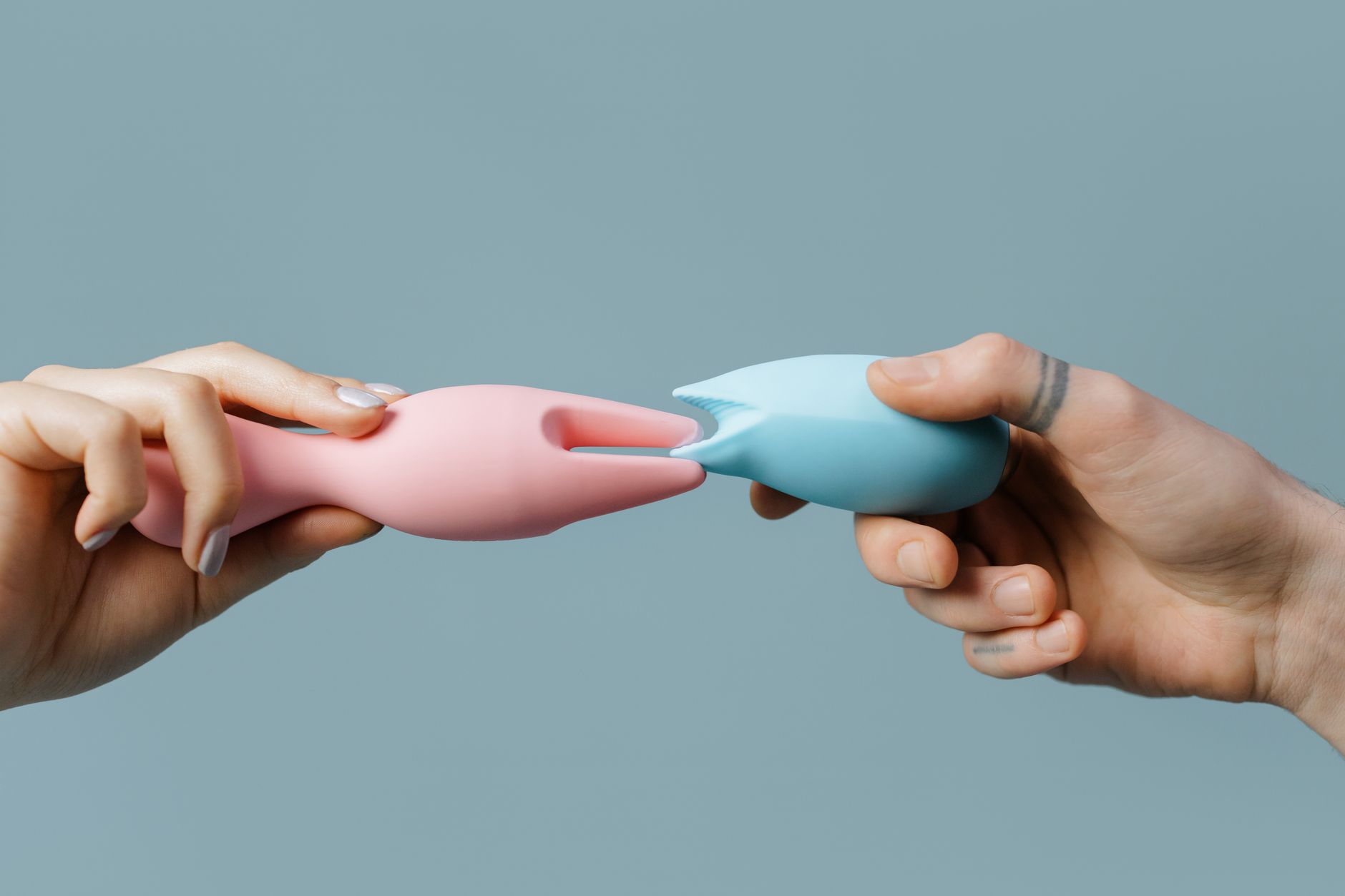
How to Use a Lemon Vibrator When You're Starting From Zero Arousal
When desire feels completely dormant, your body needs permission and a clear signal. Here's how a lemon clitoral vibrator can help you find the spark again.
Let's be real. There's a difference between low desire and no desire. Low desire means the spark is dim but still flickers. Zero arousal means you've looked for the spark and found nothing. Your body used to respond. Now it doesn't, and you're not sure it ever will again.
This happens more than anyone talks about. Depression, grief, burnout, medication side effects, relationship rupture, or just years of not prioritizing your own pleasure will do it. Your nervous system learned to ignore its own signals.
Arousal isn't a feeling that arrives on its own. It's a physical response triggered by sensory input, mental permission, and safety. When all three are missing, your body has no reason to respond. A lemon vibrator won't magically rebuild desire, but it does something more useful: it provides a reliable sensory signal that's strong enough to cut through the fog.
Your clitoris has about 8,000 nerve endings. A lemon clitoral vibrator like those offered by My Lem Vibrator uses suction and oscillation to activate all of them simultaneously. That's not subtle. Your brain can't ignore it. And when your brain registers sensation, sometimes the rest follows.
The key is starting from the ground up, not expecting your old arousal patterns to kick back in immediately.
Don't frame this as "trying to get aroused." That's a setup for failure. Frame it as exploration. Your only goal is to notice what sensation feels like. That's it. No orgasm target, no partner performance, no timeline.
Step 2: Pick a specific time and place.
Don't try to access arousal in chaotic moments or shared spaces where your nervous system is already in red alert. Pick a time when you're alone, the house is quiet, and you have at least 20 minutes uninterrupted. Your nervous system needs to know it's safe before it will respond.
Step 3: Start with external sensation only.
Hold the lemon vibrator against the outer labia first. Not inside, not on the clitoris yet. Get comfortable with the vibration against the skin you can see and control. Run it down the inner thigh. Over the mons pubis. Around the outer edges.
The goal is to let your body register: "Hey, that's a stimulus I can predict and manage." Predictability builds safety.
Step 4: Move to the clitoral hood, not the clitoris.
When you're ready, move the vibrator to the clitoral hood. The tissue covering the clitoris. This gives intense stimulation without the sometimes-overwhelming intensity of direct contact. Stay here for 2-3 minutes. Notice temperature, pressure, rhythm. Don't rate whether it feels "good" yet. Just notice.
Step 5: If your body wants more, add time, not intensity.
Don't crank the settings up. Instead, stay at the same intensity longer. Your nervous system learns arousal through extended, predictable stimulation. Ten minutes of steady pattern 1 is more effective than two minutes of pattern 6.
When arousal has shut down, the body part usually isn't broken. The nervous system has learned to protect you by staying numb. Retraining it requires more than sensation.
Expect intrusive thoughts. Your brain will generate catastrophic predictions. "This isn't working." "I'll never feel this again." "Something's wrong with me." Name them as thoughts, not facts. Keep using the lemon vibrator anyway.
Separate physical sensation from emotional meaning. You might feel tingles or warmth and immediately interpret it as "not enough" or "fake arousal." Any sensation is the opposite of zero. Tingling is progress.
Lower your threshold for "it worked." Your pre-shutdown arousal might have included racing heart, flushed skin, and intense focus. Ground-zero arousal looks like: you noticed the vibration, your breathing changed slightly, or you stayed engaged for longer than you expected. That's success.
For about 40% of people who start from zero arousal, sensation alone isn't quite enough. Your nervous system learned to shut down partly because real-world context didn't feel safe or appealing.
Once you've gotten comfortable with the physical sensation of the lemon vibrator (usually 3-5 sessions), you can add mental input. This isn't about watching porn or fantasizing about partners. It's about constructing a scenario your body recognizes as permission.
Examples: "I'm alone and no one can interrupt me." "This is just for my own pleasure, no one else's." "My body is allowed to feel good right now." Some people need visual: a memory of a time they felt attractive, a character from a book, an imagined scenario with zero pressure.
The point isn't hotness. It's coherence. Your nervous system needs the external stimulus (vibration) plus internal coherence (a narrative that feels safe) to rebuild arousal. The lemon clitoral vibrator handles the external part. Your mind handles the internal part.
Around session 5 or 6, something shifts. Your body starts to anticipate the sensation. Your breathing might deepen before you even turn it on. You might notice warmth or achiness in your pelvic floor. These are signs your system is waking up.
Don't accelerate. Keep the same protocol. Predictability is still more valuable than variety. Many people make the mistake of suddenly trying new positions, new intensities, or longer sessions. That can retraumatize your nervous system.
When desire starts returning, it won't feel like it used to. That's normal. It might feel quieter, slower, less dramatic. That's not a sign it's fake. It's a sign you're rebuilding something sustainable instead of chasing a phantom version of old arousal.
If you're working with someone, don't loop them in during this rebuilding phase unless specifically helpful. Having someone else present often reintroduces performance pressure, which is exactly what your nervous system learned to fear.
Instead, wait until you've had a few solo sessions where sensation feels straightforward. Then, if you want, you can share the experience. You might use the lemon vibrator together. You might just tell them what's happening without them in the room. The point is: their presence shouldn't create new pressure.
Some people notice shifted sensation in three sessions. Others take three weeks. Stress, sleep, medication changes, and relationship moments all affect how fast arousal rebuilds. You're not failing if progress is slower than you want.
The nervous system doesn't care about your timeline. It cares about safety and repetition. Show up consistently, and the rest follows.
Yes, but with a specific strategy. Many SSRIs flatten sensation, including sexual sensation. A lemon vibrator with suction stimulation is actually one of the more effective tools because suction activates nerves differently than traditional vibration alone. The strong, multi-directional stimulation can sometimes cut through numbness that lighter touch won't reach. Start low and slow as described above. If after 8-10 sessions you're still not registering sensation, talk to your doctor about timing your medication or adjusting your dose. Both are legitimate medical conversations.
Your body isn't broken. Full stop. Arousal is a learned response. If you learned to suppress it through circumstances or trauma, you can relearn it with the right signals and safety. That said, certain medical conditions (thyroid issues, hormonal imbalances, early menopause) can genuinely suppress arousal. If you've been using a lemon clitoral vibrator consistently for 6-8 weeks and feel zero change, a conversation with your doctor or a therapist trained in sexual health is worth it. You might be dealing with a physiological issue that needs different support.
That's common in the first 1-2 sessions. Your nervous system is still skeptical. The feeling you're noticing (or not noticing) right now is your baseline. In two weeks, you'll compare. In three weeks, you'll have more data. Arousal rebuilds through repetition, not intensity. Trust the protocol even when it feels like nothing's happening.
Yes, and it's worth examining. If the guilt is rooted in shame about your own pleasure, that's something to work through separately (therapy is genuinely helpful here). If the guilt is about secrecy in a relationship that's supposed to be transparent, that's a different issue. Rebuilding arousal from zero often requires solo space and privacy. A partner who loves you should understand that. If they don't, that's worth a conversation.
Sometimes. If your partner can be genuinely passive (not watching intensely, not trying to add input, not making it about them), that can work. But in my experience, when arousal is starting from absolute zero, having a partner present usually reintroduces the performance pressure your nervous system is trying to escape. Start solo. Once arousal feels more stable and natural, then experiment with shared experiences.
It depends on what caused the shutdown and how long it lasted. Three months of shutdown from stress might resolve in 4-6 weeks of consistent lemon vibrator use and safety rebuilding. Years of learned numbness might take 2-3 months. The good news: you don't have to feel "normal" to have good sex. You have to feel safe and capable of sensation. A lemon vibrator helps rebuild both.
Your nervous system didn't betray you. It protected you. When desire disappeared, your body was saying: "This environment isn't safe enough for arousal." Whether the environment was external (stress, relationship rupture, trauma) or internal (shame, numbness, depression), your system made a choice.
Rebuilding arousal from zero is possible. It's also slower and more intentional than you want it to be. That's not a flaw. It's how real change works.
A lemon vibrator is a useful tool in that process because it provides a signal strong enough to reach a nervous system that's learned not to listen. But it's one part of a bigger shift: rebuilding safety, permission, and the belief that your pleasure matters.
Start small. Stay consistent. Trust the timeline your body needs, not the one you think you should have. The spark doesn't return all at once. It returns in tingling, in deeper breath, in a moment when you notice you're still engaged five minutes in. Those micro-moments are where arousal begins.